
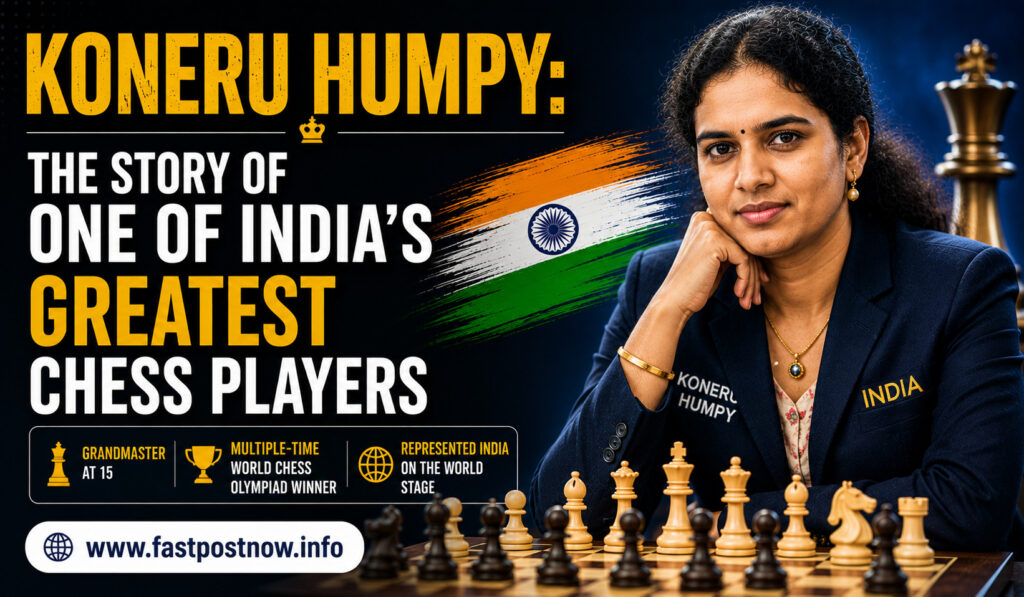
Koneru Humpy is one of the most accomplished chess players India has ever produced. For more than two decades, she has competed against the world’s strongest players and established herself as a leading figure in women’s chess.
Her journey from a talented child in Andhra Pradesh to a Grandmaster and world champion is a story of extraordinary dedication, resilience and competitive excellence.
Long before India’s current generation of young chess stars began making international headlines, Humpy was already challenging the world’s best. Her success helped demonstrate that Indian women could compete at the highest level of international chess and paved the way for the next generation.
Even after spending many years at the top, Humpy has continued to produce major performances, proving that her legacy is still being written.
Who Is Koneru Humpy?
Koneru Humpy was born on March 31, 1987, in Gudivada, Andhra Pradesh, India.
She was introduced to chess at a young age by her father, Koneru Ashok, who played an important role in her early development. Her talent became apparent very quickly, and she began competing seriously while still a child.
Humpy’s progress through the junior ranks was remarkable. She won several age-group championships and quickly began challenging older and more experienced players.
Her early success created enormous expectations, but she continued improving and eventually moved into senior international chess.
Becoming a Grandmaster
One of the defining moments of Humpy’s early career came in 2002, when she became a Grandmaster.
At just 15 years old, she became the youngest woman at that time to achieve the Grandmaster title, surpassing the previous record held by Judit Polgar.
The achievement was historic for Indian chess.
It demonstrated that an Indian woman could reach one of the highest levels of professional chess at an exceptionally young age.
Although the record was later surpassed, the significance of Humpy’s achievement remained enormous. She had established herself as a genuine international talent rather than simply a promising junior player.
Breaking Into the World’s Elite
After becoming a Grandmaster, Humpy continued climbing the international rankings.
She became one of the strongest female players in the world and regularly competed in major tournaments against leading names in women’s chess.
Her classical rating eventually crossed the important 2600 Elo mark, a level reached by only a small number of female players.
This achievement confirmed Humpy’s status as an elite competitor.
Her success also helped raise the profile of women’s chess in India at a time when the country was still developing its reputation as a global chess powerhouse.
A Pioneer for Indian Women’s Chess
Humpy’s importance extends beyond her individual results.
Before her rise, Indian chess had already been transformed by Viswanathan Anand’s international success. However, women’s chess had fewer globally recognized Indian stars.
Humpy helped change that.
Her achievements demonstrated that Indian women could compete against the strongest players from Europe, China and other major chess nations.
Her career inspired many younger Indian players, including a generation that would later include Harika Dronavalli, Vaishali Rameshbabu and Divya Deshmukh.
The growing depth of Indian women’s chess owes part of its foundation to pioneers like Humpy.
Winning the Women’s World Rapid Championship
One of the most memorable achievements of Humpy’s career came in 2019, when she won the Women’s World Rapid Chess Championship in Moscow.
The tournament featured many of the strongest female players in the world.
Humpy produced an excellent performance throughout the event and eventually secured the title after a dramatic finish.
Winning a world championship was a major milestone because it confirmed that she could convert years of elite-level experience into a global title.
The victory also came after a period away from competitive chess, making the achievement even more impressive.
Returning to Chess After Motherhood
Humpy’s career took a different direction when she stepped away from professional chess after becoming a mother.
Taking a break from elite competition can be challenging for any athlete, particularly in chess, where players must maintain sharp calculation, opening knowledge and tournament rhythm.
Humpy returned to competitive chess with renewed determination.
Her comeback was highlighted by the 2019 World Rapid Championship victory, demonstrating that elite players can successfully return after significant personal and professional changes.
Her comeback became an inspiring example of balancing family life with a demanding international career.
A Strong Classical Chess Player
Although Humpy has achieved major success in rapid chess, her classical record is equally important.
She has consistently competed near the top of the women’s world rankings and has faced some of the strongest players in the sport.
Classical chess requires long periods of concentration. Games can last several hours, and players must maintain accuracy through complex middlegames and difficult endgames.
Humpy’s ability to remain competitive in this format has helped sustain her position among the world’s elite for many years.
Success in the Women’s Candidates
Humpy has also competed in the Women’s Candidates Tournament, the elite event that determines the challenger for the Women’s World Championship.
Her participation demonstrates her sustained status among the strongest players in women’s chess.
The Candidates requires players to perform at an exceptionally high level over a long tournament. Every game carries significant pressure because the ultimate prize is a world championship opportunity.
For Humpy, these experiences have provided another chapter in her long career at the top of the sport.
Her Playing Style
Humpy’s chess is often characterized by deep calculation, strong preparation and excellent positional understanding.
She can play tactical positions when opportunities arise, but she is equally comfortable in strategic battles where patience is required.
One of her greatest strengths is her ability to remain focused during complicated games.
At the elite level, players often spend hours calculating variations and searching for small advantages. Mental endurance becomes just as important as technical skill.
Humpy’s long career demonstrates her ability to maintain concentration under this kind of pressure.
Experience as a Major Advantage
One of Humpy’s biggest advantages today is her experience.
She has spent decades competing against elite players and has experienced different eras of professional chess.
She has played before the modern dominance of computer-assisted preparation became as extensive as it is today and has adapted to the rapidly changing nature of the game.
That experience gives her valuable insight into tournament strategy, preparation and psychological pressure.
While younger players may have tremendous energy and new ideas, Humpy brings an enormous depth of competitive knowledge.
Her Influence on the Next Generation
Koneru Humpy’s success has inspired countless young chess players in India.
Her journey shows that women can pursue chess at the highest professional level and compete for major international titles.
Today’s Indian women’s chess scene is much stronger than it was when Humpy began her career.
Players such as Harika Dronavalli, Vaishali Rameshbabu and Divya Deshmukh have helped create a deeper pool of elite talent.
Humpy’s achievements form an important part of that history.
India’s Growing Chess Power
Humpy’s career also reflects India’s broader transformation into a global chess powerhouse.
Viswanathan Anand’s world championship success helped put India on the international chess map.
Humpy and other leading players expanded that influence, while the current generation has taken it even further.
Today, India has multiple elite Grandmasters competing at the highest level in both open and women’s chess.
This development has created a stronger competitive environment for young players and increased interest in chess across the country.
Why Koneru Humpy’s Legacy Matters
Humpy’s legacy is not based on one tournament or one record.
It is built on sustained excellence.
She became a Grandmaster as a teenager, reached the top levels of women’s chess, won a world championship and successfully returned to elite competition after taking time away from the sport.
Her career has also lasted long enough to span multiple generations of Indian chess.
That longevity is one of the clearest signs of her greatness.
She has remained relevant even as a new wave of talented young players has emerged.
The Road Ahead
At 39, Humpy continues to be a major presence in international chess.
Her experience makes her a dangerous opponent, particularly in high-pressure tournaments where preparation and psychological strength are crucial.
She can also serve as an important source of inspiration for India’s younger players.
The next phase of her career may involve competing for more international titles while continuing to contribute to the development of Indian chess.
Whatever comes next, her place in Indian chess history is already secure.
Conclusion
Koneru Humpy’s story is one of talent, determination and remarkable longevity.
From becoming a Grandmaster at just 15 to winning the Women’s World Rapid Championship and competing against the world’s strongest players for more than two decades, she has achieved an extraordinary amount in her career.
Her influence extends beyond her trophies and rankings. She helped establish India as an important force in women’s chess and inspired a new generation of Indian players to dream bigger.
As Indian chess continues to produce world-class talent, Koneru Humpy remains one of the figures who helped make that success possible.
Her journey is a reminder that greatness in chess is not only about winning games. It is also about staying at the highest level, adapting to change and inspiring the players who come next.
Koneru Humpy has done all three and that is why she remains one of India’s greatest chess players.