
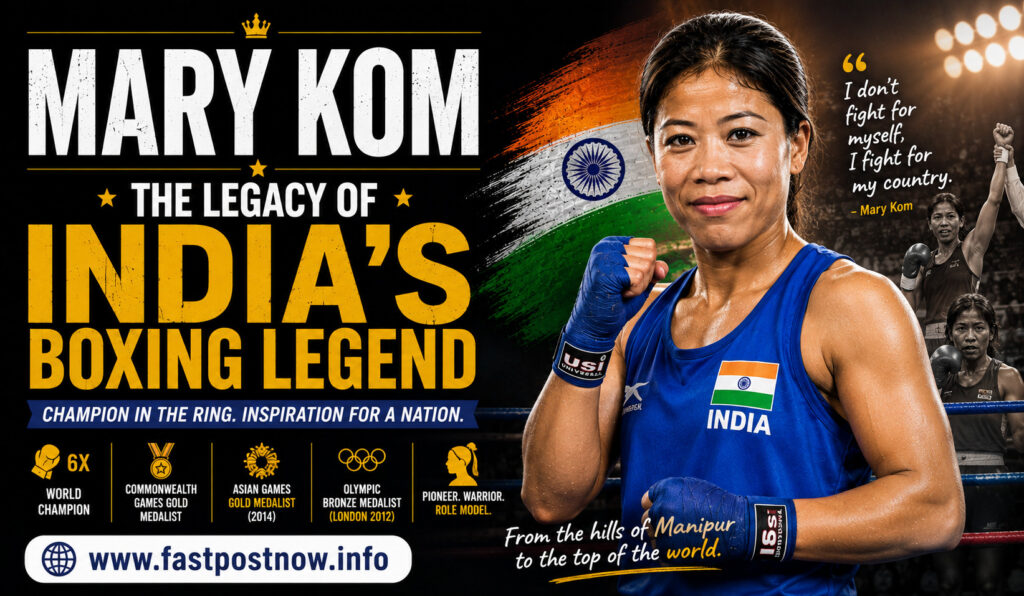
Mary Kom is one of the most celebrated athletes in Indian sporting history. Known for her extraordinary determination, fighting spirit and remarkable longevity, she transformed women’s boxing in India and became an inspiration for millions of young athletes.
From a small village in Manipur to the Olympic podium and multiple world championship titles, Mary Kom’s journey is far more than a collection of medals. It is a story of ambition, resilience and the courage to continue competing even when the odds appeared difficult.
Her achievements have made her one of the most recognizable figures in Indian boxing and one of the most successful female boxers in the history of the sport.
Who Is Mary Kom?
Mangte Chungneijang Mary Kom, popularly known as Mary Kom, was born on November 24, 1982, in Kangathei village in Manipur.
Growing up in a modest family, she developed an interest in athletics and sports during her childhood. Boxing, however, was not initially her main sporting focus.
Her interest in boxing grew after she became inspired by the success of fellow Manipuri boxer Dingko Singh. His achievements helped demonstrate that athletes from the region could reach the highest levels of the sport.
Mary eventually decided to pursue boxing seriously. That decision would change Indian women’s boxing forever.
The Beginning of Mary Kom’s Boxing Journey
Mary Kom started training as a boxer when women’s boxing had far less recognition in India than it has today.
The sport demanded intense physical preparation and mental toughness. For a young woman from a rural background, pursuing boxing professionally required determination not only inside the ring but also outside it.
She began competing in local and national tournaments and quickly established herself as a talented fighter.
Her performances at the national level gave her the confidence to compete internationally. Before long, she was representing India at major global competitions.
Becoming a World Champion
Mary Kom’s breakthrough on the international stage came at the AIBA Women’s World Boxing Championships.
She won her first world championship gold in 2002 and continued to dominate women’s boxing over the following years.
Her ability to maintain success across different editions of the World Championships was particularly impressive. While many athletes struggle to remain at the top for several seasons, Mary repeatedly returned to major competitions and challenged for medals.
She eventually won six World Championship gold medals, an achievement that established her as one of the most successful women boxers in the history of the competition.
Her consistency became one of the defining characteristics of her career.
Olympic Glory
One of the most important chapters in Mary Kom’s career came at the 2012 London Olympic Games.
Women’s boxing made its Olympic debut at London 2012, and Mary represented India in the flyweight category.
She advanced through the competition and eventually won a bronze medal.
The achievement was historic. Mary Kom became the first Indian woman boxer to win an Olympic medal.
Her Olympic success elevated her profile far beyond the boxing community. Millions of Indians followed her journey, and her bronze medal became one of the memorable moments of Indian sport at the Games.
More Than a Boxer
Mary Kom’s influence has never been limited to boxing.
Her career helped change public perceptions about women participating in physically demanding sports. At a time when female athletes often had fewer opportunities and less visibility, her success demonstrated that women could build international careers in boxing.
Her journey also showed that athletes do not necessarily have to come from major metropolitan cities to reach the global stage.
Mary’s success became particularly meaningful for young athletes from India’s Northeast, where she became a powerful symbol of sporting possibility.
Balancing Motherhood and Elite Sport
One of the most remarkable aspects of Mary Kom’s career has been her ability to balance motherhood with professional sport.
After becoming a mother, she returned to competitive boxing and continued winning major medals.
Her comeback challenged the idea that motherhood should mark the end of an elite sporting career.
Returning to the ring required significant physical preparation and mental discipline. Mary continued training, competing and adapting as she moved forward in her career.
Her story has inspired many women who want to pursue ambitious careers while also managing family responsibilities.
The Mental Strength Behind Mary Kom’s Success
Boxing is a sport where physical ability alone is not enough. Fighters need confidence, discipline and the ability to recover from disappointment.
Mary Kom’s career has repeatedly demonstrated these qualities.
She faced defeats and difficult periods but consistently returned to training. Instead of allowing setbacks to define her career, she treated them as opportunities to improve.
Her fighting spirit became a major part of her public image. Fans admired not only her punches and technique but also her refusal to give up.
That mentality helped her remain competitive for an unusually long period.
Mary Kom’s Boxing Style
Mary Kom has been known for her speed, movement and ability to attack from different angles.
Her compact frame and quick combinations allowed her to close distances and create scoring opportunities. She combined technical ability with excellent conditioning and ring intelligence.
Another important quality was her experience. Years of competing against international opponents gave her an understanding of different boxing styles.
She could adjust her approach depending on the opponent, making her difficult to predict.
Awards and Recognition
Mary Kom’s achievements have earned her some of India’s highest sporting honours.
She received the Rajiv Gandhi Khel Ratna Award, India’s highest sporting honour at the time, and was later honoured with the Padma Bhushan and Padma Vibhushan for her contributions to Indian sport.
She has also received numerous other national and international recognitions.
These awards reflect the significance of her contribution not only to boxing but to Indian sport as a whole.
Mary Kom’s Contribution to Indian Boxing
Mary Kom helped create a stronger platform for women’s boxing in India.
Before her rise, opportunities and public attention for female boxers were relatively limited. Her international success helped change that environment.
The emergence of later champions and medal winners, including Nikhat Zareen and Lovlina Borgohain, represents the broader growth of Indian women’s boxing.
Mary’s achievements helped demonstrate that Indian women could compete successfully against the world’s best.
Her legacy therefore extends beyond her individual record.
A Role Model for Young Athletes
Mary Kom’s story continues to inspire young athletes across India.
Her journey teaches several important lessons: success requires patience, setbacks do not have to end a career, and determination can overcome difficult circumstances.
For young girls especially, her career represents a powerful message about confidence and independence.
She showed that women can succeed in sports traditionally dominated by men and can continue pursuing their ambitions despite social or personal challenges.
The Lasting Legacy of Mary Kom
Mary Kom’s legacy is built on much more than medals.
She changed the visibility of women’s boxing in India, inspired a generation of athletes and demonstrated the importance of resilience in elite sport.
Her story has also become part of India’s wider sporting culture. She is no longer remembered simply as a boxer who won world titles. She is remembered as an athlete who helped redefine what Indian women could achieve in boxing.
Even as new generations of boxers emerge, Mary Kom’s influence remains visible.
Conclusion
Mary Kom’s journey from a village in Manipur to becoming a six-time world champion and Olympic medallist is one of the greatest stories in Indian sport.
Her career combined talent with extraordinary discipline and mental strength. She overcame setbacks, returned to competition after motherhood and continued performing at the highest level for many years.
Her legacy reaches far beyond the boxing ring. Mary Kom opened doors for future generations of Indian women boxers and showed millions of young athletes that their dreams are worth pursuing.
For India, she will always remain more than a champion. Mary Kom is a symbol of determination, courage and the enduring spirit of Indian sport.