
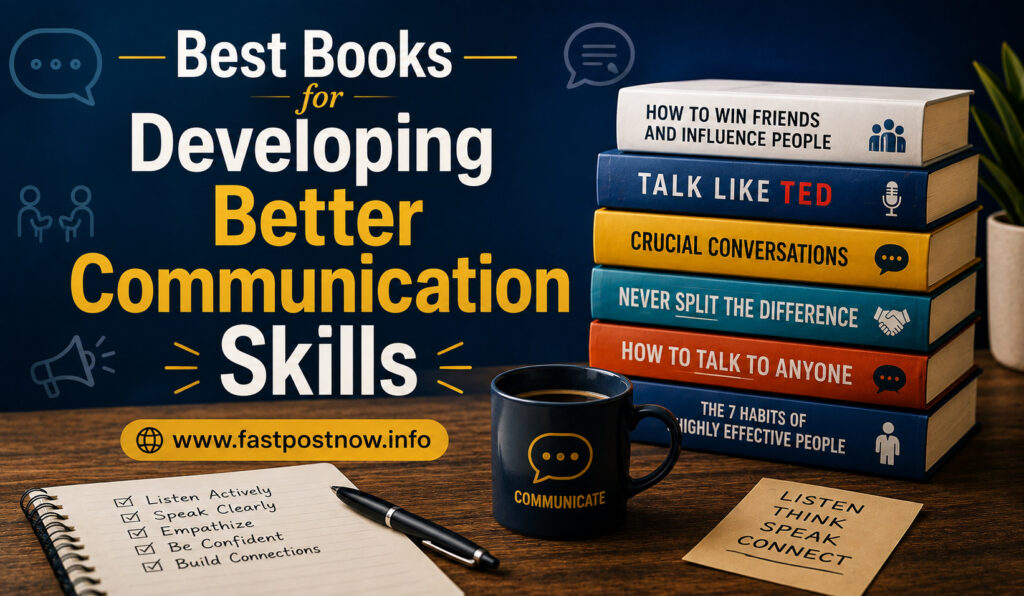
Communication is one of the most important skills in everyday life. Whether you are speaking with a colleague, managing a team, meeting new people, having a difficult conversation, or maintaining a personal relationship, the ability to express yourself clearly can make a significant difference.
Good communication is not simply about talking more or finding impressive words. It involves listening carefully, understanding other people’s perspectives, choosing the right tone, asking useful questions, and explaining ideas in a way that others can understand. It also involves knowing when to speak, when to pause, and when to listen.
The good news is that communication can be improved with practice. Books can provide useful frameworks for understanding conversations, relationships, persuasion, confidence, and emotional awareness. The right book can help you recognize habits that may be limiting your communication and replace them with more effective approaches.
If you want to become a clearer speaker, better listener, or more confident communicator, these books offer excellent places to begin.
Why Communication Skills Matter
Communication affects almost every area of life. At work, clear communication can reduce misunderstandings and help teams cooperate. In personal relationships, honest conversations can build trust and prevent small problems from becoming larger conflicts.
Even simple conversations can become difficult when people assume they understand each other without actually listening. Tone, body language, timing, and word choice can all influence how a message is received.
Strong communication skills can help you:
- Express ideas more clearly.
- Listen with greater attention.
- Handle disagreements more constructively.
- Build stronger personal and professional relationships.
Improving these abilities does not mean becoming perfectly confident in every conversation. It means becoming more intentional about how you communicate.
How to Win Friends and Influence People by Dale Carnegie
How to Win Friends and Influence People is one of the best-known books on interpersonal communication.
The book focuses on principles such as showing genuine interest in other people, listening carefully, avoiding unnecessary criticism, and recognizing the importance of appreciation.
Its central lesson is that communication is not only about getting your own message across. People also want to feel heard, respected, and valued.
For beginners, the book offers a useful introduction to relationship-focused communication. Some examples reflect the period in which the book was written, but many of its basic ideas about human interaction remain easy to understand and apply.
Nonviolent Communication by Marshall B. Rosenberg
Nonviolent Communication focuses on communicating honestly while reducing blame, judgment, and unnecessary conflict.
The approach encourages people to distinguish between observations, feelings, needs, and requests. This can help make difficult conversations more specific and less emotionally charged.
For example, instead of accusing someone of “never listening,” a person can describe a particular situation, explain how it affected them, and communicate what they need.
The book is particularly useful for readers who want to improve communication in relationships or learn how to handle disagreements more calmly.
Crucial Conversations by Kerry Patterson and Others
Some conversations are difficult because the topic matters, emotions are strong, and the consequences are significant.
Crucial Conversations focuses on these situations. It explores how people can communicate when disagreements become emotionally intense without allowing the conversation to become hostile or unproductive.
The book emphasizes creating a safe environment for dialogue and learning to recognize when emotions are affecting the way you communicate.
This makes it particularly useful for workplace conversations, family disagreements, and situations where avoiding the topic is no longer practical.
How to Talk to Anyone by Leil Lowndes
For readers who struggle with starting conversations or feeling comfortable around unfamiliar people, How to Talk to Anyone offers practical suggestions.
The book covers social interaction, conversation starters, confidence, body language, and ways of making conversations more engaging.
Its advice is presented in small, actionable ideas, making it easy to experiment with different approaches.
The book is especially suitable for people who want to become more comfortable at social events, networking situations, or everyday conversations.
Talk Like TED by Carmine Gallo
Talk Like TED focuses on presentation and public speaking rather than everyday conversation alone.
It explores ways speakers can make presentations more engaging, memorable, and emotionally meaningful.
For professionals, students, entrepreneurs, and anyone who needs to speak in front of groups, the book can provide useful ideas about storytelling, enthusiasm, structure, and presentation style.
Its broader lesson is that effective communication is not only about information. The way information is delivered can strongly influence whether people remember it.
Just Listen by Mark Goulston
Just Listen focuses heavily on listening and emotional connection.
Many people think of communication as speaking, but listening is equally important. People are more likely to communicate openly when they believe they are being understood.
The book explores ways to reduce defensiveness and create conversations in which people feel comfortable expressing themselves.
This can be particularly useful when dealing with emotional conversations, workplace tension, or people who initially resist communication.
The Charisma Myth by Olivia Fox Cabane
The Charisma Myth examines charisma as a skill rather than something that only certain people naturally possess.
The book discusses presence, confidence, warmth, and the way people influence social interactions.
For readers who feel nervous in professional or social situations, the book offers ideas for becoming more present and comfortable rather than attempting to imitate a particular personality.
It is useful for anyone interested in improving interpersonal presence and confidence.
Books for Different Communication Goals
Different communication challenges require different approaches. A person who wants to become a better public speaker may not need the same book as someone trying to improve difficult conversations.
| Communication Goal | Recommended Book | Main Benefit |
| Building relationships | How to Win Friends and Influence People | Understanding people |
| Handling conflict | Nonviolent Communication | Expressing needs clearly |
| Difficult conversations | Crucial Conversations | Managing emotional discussions |
| Social confidence | How to Talk to Anyone | Starting conversations |
| Public speaking | Talk Like TED | Creating engaging presentations |
| Listening | Just Listen | Building understanding |
| Confidence and presence | The Charisma Myth | Improving social presence |
You do not need to read all of these books. Start with the communication area that causes you the most difficulty.
The Importance of Listening
One of the biggest communication mistakes is preparing your response while the other person is still speaking.
Listening requires attention. Instead of immediately deciding whether you agree or disagree, try to understand what the person actually means.
Good listening can involve asking follow-up questions, summarizing what you heard, and allowing the other person enough time to finish their thought.
People often remember how a conversation made them feel. Someone who feels genuinely heard may be more willing to trust you and communicate openly in the future.
How to Become a Clearer Speaker
Clear communication does not require complicated vocabulary. In many situations, simple language is more effective.
Before explaining something important, consider what the other person actually needs to know. Avoid adding unnecessary information simply because you know it.
A clear message usually has a central point. If the conversation is complicated, break the information into smaller parts.
Some useful habits include:
- Think about your main point before speaking.
- Use straightforward language.
- Give examples when an idea is difficult.
- Pause instead of rushing through important information.
Clarity becomes especially important in professional communication, where misunderstandings can waste significant amounts of time.
Communication Is More Than Words
Body language, facial expressions, tone, posture, and timing can all influence communication.
A person may say that everything is fine while sounding uncomfortable. Another person may speak confidently but appear distracted because they are constantly checking their phone.
This does not mean body language should be treated as a perfect system for detecting what people secretly think. Human behavior is more complicated than that.
Instead, consider nonverbal communication as additional context. Your own posture, attention, and tone can also affect how your message is received.
Practicing Communication Skills in Everyday Life
Communication improves through practice, not simply through reading.
After learning an idea from a book, look for opportunities to use it in ordinary conversations. Ask someone a thoughtful follow-up question. Practice summarizing what another person said before responding. Try explaining a complicated idea in fewer words.
You can also review conversations afterward. Think about what worked, what created confusion, and whether you listened as carefully as you spoke.
Useful practice situations include:
- Team meetings.
- Family conversations.
- Networking events.
- Presentations and interviews.
Everyday interactions provide opportunities to improve without requiring a formal course.
Avoiding Common Communication Mistakes
Even skilled communicators can fall into unhelpful habits. Interrupting, assuming intentions, becoming defensive, and focusing on winning an argument can quickly damage a conversation.
Another common problem is avoiding difficult conversations completely. Avoidance may create temporary comfort, but unresolved issues often become harder to address later.
Effective communication does not mean agreeing with everyone. It means expressing disagreement respectfully and creating enough space for both sides to be understood.
The goal is not to eliminate conflict. Some disagreements are unavoidable. The goal is to handle them without unnecessarily damaging the relationship.
Frequently Asked Questions
What is the best book for improving communication skills?
How to Win Friends and Influence People is a popular starting point for interpersonal communication. For difficult conversations, Crucial Conversations and Nonviolent Communication offer more specialized approaches.
Can reading books really improve communication?
Books can teach useful principles and provide practical techniques, but improvement requires practice. Applying one communication idea repeatedly is usually more valuable than reading many books without changing your behavior.
What is the most important communication skill?
Listening is one of the most important skills because effective communication requires understanding as well as speaking. Good listening can improve relationships, reduce misunderstandings, and make conversations more productive.
How can I become more confident when speaking?
Prepare your main points, slow down your speech, practice regularly, and focus on communicating your message rather than trying to appear perfect. Confidence usually develops through repeated experience.
Which book is best for difficult conversations?
Crucial Conversations is a useful choice for readers who want to handle emotionally sensitive discussions. Nonviolent Communication is another valuable option for expressing feelings and needs without unnecessary blame.
Final Thoughts
Better communication is not about becoming the loudest or most persuasive person in the room. It is about becoming clearer, more attentive, more empathetic, and more intentional.
Books such as How to Win Friends and Influence People, Nonviolent Communication, Crucial Conversations, How to Talk to Anyone, Talk Like TED, Just Listen, and The Charisma Myth provide different approaches to improving communication.
Choose a book based on the area you want to strengthen. If you struggle with listening, focus on listening. If difficult conversations are your challenge, explore conflict communication. If public speaking makes you nervous, study presentation techniques.
Most importantly, practice what you learn. A communication skill becomes valuable when it changes the way you handle real conversations. Small improvements in listening, clarity, empathy, and confidence can gradually transform both professional interactions and personal relationships.