
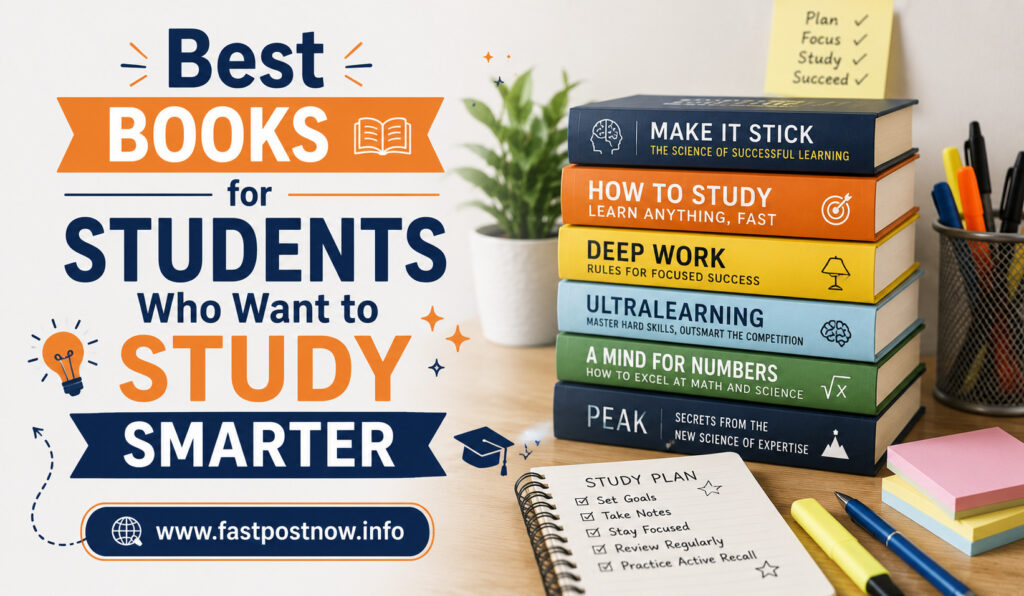
Studying harder does not always mean studying better. Many students spend long hours reading notes, highlighting textbooks, or repeatedly reviewing the same material without seeing the results they expect. The real difference often comes from understanding how learning works and choosing study methods that make time and attention more effective.
Books about learning, concentration, memory, productivity, and academic success can help students develop better study habits. They can explain why certain techniques work, how distractions affect concentration, and how to remember information more effectively.
The best books for students are not necessarily those that promise perfect grades or instant success. Instead, they encourage practical habits that can be used consistently. Whether you are preparing for school exams, university assessments, competitive tests, or simply trying to become a more effective learner, the following books offer valuable ideas.
Why Students Should Learn How to Study Smarter
Students often assume that academic success depends mainly on intelligence. In reality, study habits, planning, concentration, sleep, practice, and the ability to manage distractions can have a major influence on learning.
A student who studies for three focused hours may accomplish more than someone who spends six hours switching between notes, social media, messages, and unrelated tasks.
Studying smarter means paying attention to how you learn rather than simply increasing the number of hours you spend studying.
Some useful areas to improve include:
- Memory and information retention.
- Concentration and distraction management.
- Time management and planning.
- Effective revision and practice.
Understanding these areas can help students build a study system that is both productive and sustainable.
Make It Stick by Peter C. Brown, Henry L. Roediger III, and Mark A. McDaniel
Make It Stick is an excellent choice for students who want to understand how learning and memory work.
One of its important ideas is that learning can be stronger when students actively retrieve information instead of repeatedly reading the same material.
This means closing the textbook and trying to remember the main concepts, answering questions without looking at the solution, or explaining an idea in your own words.
The book also explores the value of spacing learning over time rather than attempting to memorize everything in a single session.
For students who spend hours rereading notes without remembering much later, this approach can change the way they study.
Atomic Habits by James Clear
Although Atomic Habits is not specifically an academic study guide, its principles are highly relevant to students.
Successful studying depends heavily on consistency. Waiting until you feel motivated can lead to irregular routines, especially when assignments and exams become stressful.
The book emphasizes making habits easier to start and creating environments that support desired behaviors.
For a student, this might mean keeping study materials ready, choosing a regular study time, or removing distracting apps during focused sessions.
The larger lesson is that academic progress can be built through small actions repeated consistently.
Deep Work by Cal Newport
Deep Work is especially useful for students who struggle to concentrate.
Studying often requires extended attention, yet students have access to more distractions than ever. Notifications, entertainment, social media, and constant messaging can interrupt concentration before meaningful learning takes place.
The book explores ways to create periods of uninterrupted focus. Students can apply these ideas by studying in distraction-free environments and setting specific periods for concentrated work.
The goal is not necessarily to study for extremely long hours. It is to make the time spent studying more focused and productive.
How to Become a Straight-A Student by Cal Newport
How to Become a Straight-A Student is specifically aimed at students who want to improve their academic performance without allowing schoolwork to consume their entire lives.
The book discusses planning, organization, studying, note-taking, and exam preparation.
One of its useful lessons is that students can benefit from treating academic work as a system rather than relying on last-minute effort.
Instead of waiting until an examination is close, students can organize assignments, review material regularly, and prepare in advance.
This approach can reduce stress while creating more consistent academic performance.
A Mind for Numbers by Barbara Oakley
A Mind for Numbers is particularly useful for students who find mathematics, science, or other technical subjects challenging.
The book explores learning strategies that can make difficult subjects more manageable. It discusses concentration, problem-solving, memory, and the importance of approaching challenging material in different ways.
One valuable lesson is that struggling with a difficult concept does not necessarily mean you are incapable of learning it. Sometimes the problem is the method being used.
Students can benefit from switching between focused problem-solving and periods in which they allow their minds to process ideas more freely.
The Power of Habit by Charles Duhigg
The Power of Habit explores why repeated behaviors become automatic and how routines can be changed.
For students, understanding habits can make it easier to identify why certain study routines succeed while others fail.
A student may intend to study after dinner but automatically begin watching videos instead. Recognizing the trigger and routine can make it easier to redesign the environment.
The book is useful for students who know what they should do but struggle to turn intentions into consistent behavior.
Mindset by Carol S. Dweck
Mindset explores the relationship between beliefs and learning.
The book introduces the distinction between fixed and growth-oriented ways of thinking. A fixed approach may cause students to interpret difficulty as evidence that they are not capable, while a growth-oriented approach treats challenges as opportunities to develop.
This perspective can be valuable during difficult academic periods.
Students will inevitably encounter subjects they find challenging. Instead of assuming that difficulty means failure, they can treat mistakes as information about what needs more practice.
Comparing Books for Smarter Studying
The right choice depends on what you currently struggle with.
| Book | Main Focus | Best For |
| Make It Stick | Memory and learning | Better retention |
| Atomic Habits | Habit formation | Consistent studying |
| Deep Work | Concentration | Reducing distractions |
| How to Become a Straight-A Student | Academic organization | Study planning |
| A Mind for Numbers | Learning difficult subjects | Math and science students |
| The Power of Habit | Behavioral routines | Changing study patterns |
| Mindset | Learning beliefs | Handling academic challenges |
You do not need to read every book. Choose one that matches your biggest study problem and experiment with its ideas.
Why Active Recall Is Better Than Passive Reading
One of the most important lessons students can learn is the difference between recognizing information and actually remembering it.
When you reread a chapter, the material may feel familiar. However, familiarity does not always mean you can reproduce the information during an exam.
Write down the major ideas, solve practice questions, or explain the concept without looking at your materials.
This creates a more demanding learning experience, but that effort can make your understanding stronger.
The Value of Spaced Revision
Another useful study principle is spreading revision across multiple sessions.
Instead of studying one chapter intensely for several hours and then ignoring it for weeks, revisit important material at intervals.
A simple revision pattern might involve reviewing material after a short interval, returning to it later in the week, and testing yourself again before an examination.
The exact schedule can vary depending on the subject and exam date.
How Students Can Build a Smarter Study Routine
A good study routine does not need to be complicated. The most important thing is that it can realistically fit into your daily life.
Start by identifying when you are most alert. Then decide what you want to accomplish before beginning a session. “Study chemistry” is vague. “Complete twenty practice questions on chemical equations” gives you a specific target.
A practical routine can include:
- A clear study goal.
- A distraction-free environment.
- Short breaks between focused sessions.
- Active testing instead of constant rereading.
The routine should be adjusted when it stops working rather than treated as a rigid rule.
Managing Technology While Studying
Technology can be extremely useful for students, but it can also make concentration difficult.
A single notification can interrupt a study session.
Students do not necessarily need to eliminate technology completely. Instead, they can decide which digital tools genuinely support their learning.
Turning off unnecessary notifications, placing the phone away from the desk, and using websites or applications only when needed can create a quieter environment.
The objective is to make focused studying the easiest option.
Why Rest Is Part of Effective Studying
Studying smarter does not mean studying every waking hour.
Sleep and rest are important parts of learning. When students regularly sacrifice sleep for late-night studying, concentration and memory can suffer.
Breaks can also help prevent mental fatigue. A short period away from a difficult problem can sometimes make it easier to return with a fresh perspective.
A balanced academic routine should include studying, rest, movement, social time, and other activities. Sustainable learning is more useful than short bursts of extreme effort.
Common Study Mistakes Students Should Avoid
Common mistakes include:
- Rereading notes without testing memory.
- Studying only immediately before an exam.
- Multitasking while trying to learn.
Another mistake is measuring progress by hours instead of understanding. Five focused hours do not automatically mean five productive hours.
Ask yourself whether you can explain the material, solve relevant problems, and recall key information without looking at your notes.
Those measures can provide a clearer picture of actual learning.
Frequently Asked Questions
Is rereading a good study method?
Rereading can provide familiarity with a topic, but it is often less effective than actively retrieving information. Testing yourself, solving practice problems, and explaining concepts from memory can make study sessions more engaging.
Can productivity books actually help students?
Yes, when their ideas are adapted to academic life. Books about habits, focus, planning, and time management can help students create better routines, although academic success still requires subject-specific learning and practice.
Final Thoughts
Studying smarter is not about discovering a secret shortcut. It is about understanding how learning works and building habits that make effective study more likely.
Books such as Make It Stick, Atomic Habits, Deep Work, How to Become a Straight-A Student, A Mind for Numbers, The Power of Habit, and Mindset offer different perspectives on learning, concentration, habits, and academic performance.
The most useful lesson is to become an active participant in your own learning. Test your memory instead of only rereading. Space your revision instead of relying on last-minute cramming. Protect your attention instead of allowing every notification to interrupt you.
Most importantly, give yourself time to improve. Better study habits develop through repeated practice. Once you learn how to study more effectively, the benefits can extend beyond a single exam and become skills you carry into university, work, and lifelong learning.